Fazenda Marambaia: A Garden, a Banker, and Serra Life Reinvented

Created as a summer residence, the property in Corrêas went through changes of ownership, financial upheavals, and a landscape restoration before becoming a hotel and a high-end condominium.
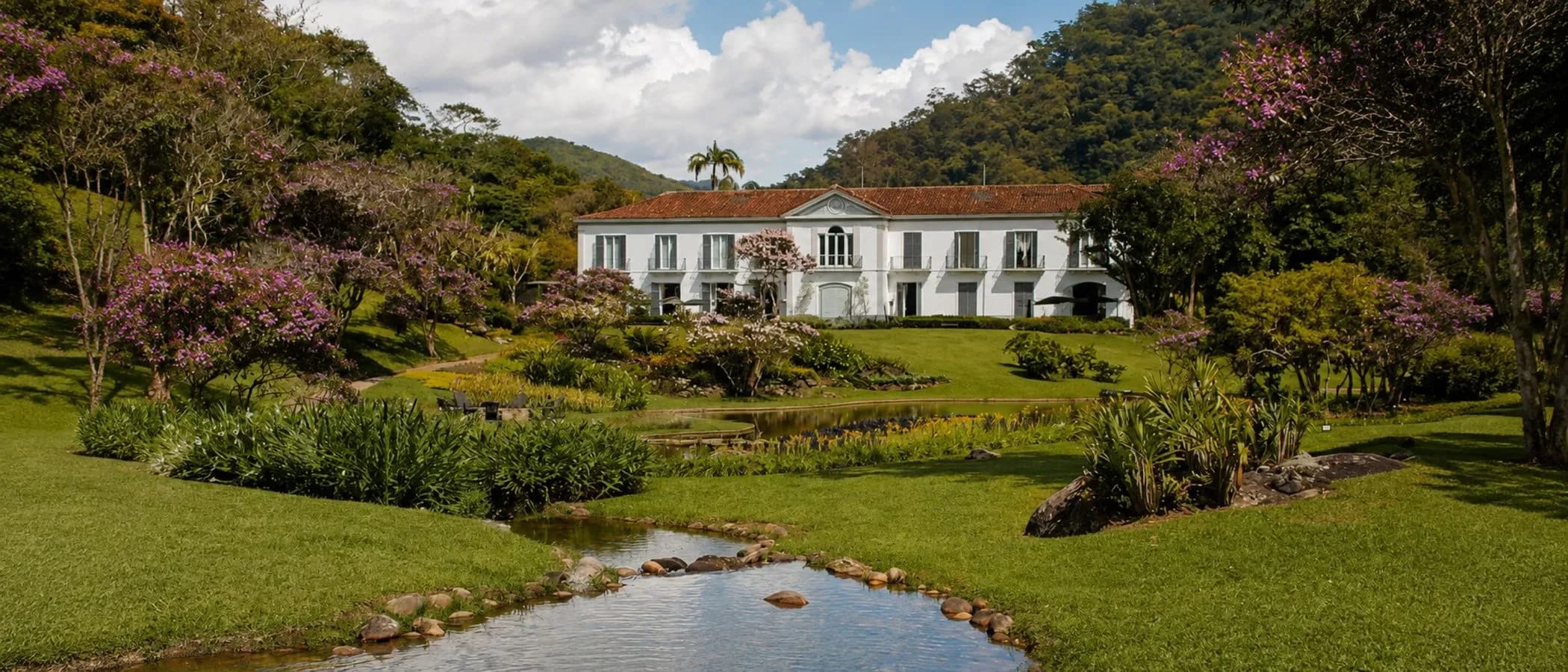
Before the contemporary homes, the boutique hotel, and the wellness experiences, there was a private residence and a garden that seemed to extend into the mountains. Fazenda Marambaia, in Corrêas, Petrópolis, Rio de Janeiro, holds a story where architecture, landscape design, and the financial market meet. To understand it, one must go back to the 1940s, when Odette and Júlio Monteiro chose that setting for their summer home.
The available sources say little about the couple’s personal lives. Their presence in the story was recorded mainly through the property they commissioned: a manor house designed by Wladimir Alves de Sousa, surrounded by gardens by Roberto Burle Marx. The work would become known in the landscaper’s repertoire as Odette Monteiro Residence, the name that remains in the records of his foundation.
An episode helps explain the Monteiros’ relationship with the project. According to a report published by Papo de Paisagista, Júlio waived the review of the garden’s preliminary design, so great was his trust in Burle Marx. The freedom allowed the artist to shape the relationship between vegetation, water, stones, and topography. The result received an award at the 1953 São Paulo Biennial. It was not just a garden to be seen from the veranda: it was a landscape to walk through.
The banker who made the farm his home
Decades later, Marambaia entered Luiz Cezar Fernandes’ life. His path had begun far from the estate’s grand salons. As a teenager, he worked as a messenger at Bradesco, delivering correspondence and learning the bank’s routines. In an interview with piauí magazine, he said he looked for extra tasks after his external duties. By age 16, he was already a proxy representative; at 17, he was transferred to Rio.
In the 1970s, he became a partner of Jorge Paulo Lemann at Garantia. In 1983, he founded Pactual with André Jakurski and Paulo Guedes. His career was marked by the creation of businesses, but also by disagreements over their direction. At Pactual, he advocated expanding into retail banking, while other partners preferred to remain focused on investments. Financial problems in his personal companies were added to the partnership disputes, and Fernandes definitively left the bank in 1999.
When he moved to Marambaia in 1987, his career was still expanding. The farm received his art collection and became both a residence and, later, a workspace. Burle Marx and Haruyoshi Ono were called in for new interventions, with additions to the gardens, waterfalls, and a ceramic panel.
After leaving Pactual, Fernandes tried to rebuild his business activities within the farm itself. Former stables housed meeting rooms; the hangar received a telecommunications operation. Between commitments, he oversaw the raising of Santa Inês sheep. Marambaia was, at once, a home, a business, and a place to begin again.
A change in destination
The transition to the current development did not begin with a simple decision to turn the residence into a hotel. It was preceded by financial difficulties and asset disputes. In 2010, Fernandes turned to André Esteves, his former collaborator at Pactual, to avoid losing the property due to a debt.
In 2018, O Globo was already reporting a real estate project on the site. According to Fernandes’ account published at the time, the construction company involved was a partner in a fund managed by BTG Pactual. This record establishes the bank’s link to the farm’s transformation, although it does not allow us to state that the institution is its direct owner today.
The new phase took shape with the restoration of the main house and the gardens. By late 2020, Casa Marambaia had begun hosting guests; in 2021, the condominium developed by Pilar already had its first homes sold. Hospitality, initially managed by Promenade, and the residential development advanced in parallel. The former private estate began to bring together living, lodging, and dining.
The opportunity met a changing audience. The pandemic increased demand for homes outside major urban centers, including for permanent use. At Marambaia, the idea was to offer the country-house experience paired with infrastructure and services, taking advantage of a landscape whose identity had been established long before the real estate launches.
High-end living without losing its identity
The condominium developed in stages. Later projects brought in architects such as Thiago Bernardes and Gisele Taranto, reinforcing its high-end positioning. Contemporary architecture entered this story with a proposal centered on comfort and integration with the surroundings, tied to sports, gastronomy, and a slower pace of life.
Today, Fazenda Marambaia presents its commercial concept as a healthness farm: living connected to nature, physical activity, and well-being. Trails, common areas, sports activities, and relaxation options make up the advertised experience, while Casa Marambaia concentrates lodging and gastronomy. Each operation has its own access and usage conditions.
The change is significant: a family retreat has become the address of many others. But the main distinction did not begin with the condominium. It lies in the meeting between the garden, the manor house, and the mountains — a relationship built over decades. Marambaia’s future will also depend on preserving that balance: allowing new uses without making unrecognizable the place that made them possible.